Anatomy of a Prompt: The Complete Guide to Crafting Effective AI & ChatGPT Prompts
Master prompt engineering with the seven-layer framework: Role, Goal, Format, Guardrails, Context, Examples, and Reasoning. Learn how to craft prompts that boost accuracy and reduce hallucinations.
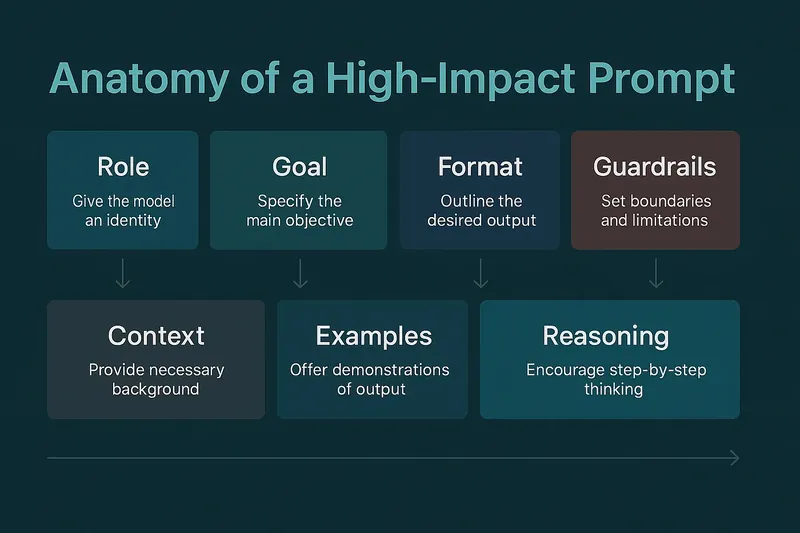
Prompt engineering boils down to giving an LLM a role, a job, the rules of the game, the raw material, and (when needed) a worked example + room to think. Industry guides from OpenAI, Google Cloud, Amazon Bedrock, Anthropic, Lakera, Guardrails AI and peer‑reviewed studies all show that a layered prompt built this way can lift factual accuracy, stylistic consistency, and guardrail compliance — sometimes by double‑digit percentages.(References at end)
The Seven‑Layer Anatomy (with "weak → strong" reminders)
1 — Role / Persona
Tell the model who it is: "You are a senior policy analyst." Assigning a role primes domain knowledge and — per a 2024 NAACL study — adds ~10 points to zero‑shot reasoning scores.(ACL Anthology)
Weak: "Explain churn." → Strong: "As a SaaS CFO, explain churn…"
2 — Goal / Directive
Lead with a single verb‑first task: "Compare Q2 vs Q1 KPIs." Google lists clear directives as the #1 prompt rule.(Google Cloud)
Weak: "Write something." → Strong: "Summarise this report in 3 bullets."
3 — Return Format & Output Constraints
State structure, length and tone: "Return JSON with keys title, summary (≤ 120 words)." AWS docs show explicit format tags reduce off‑spec answers and token waste. (AWS Documentation)
4 — Warnings / Constraints
Add guardrails: "Only use; if unsure, reply 'I don't know'; cite sources." OpenAI and Guardrails AI both find that such rules sharply cut hallucinations.(OpenAI Help Centre, guardrails) Lakera recommends wrapping context in triple quotes or XML to resist prompt‑injection (lakera.ai)
5 — Context / Background
Paste only the excerpts the model needs; extra fluff hurts relevance and consumes tokens.
6 — Examples (Few‑Shot)
Show one or two ideal input→output pairs. An arXiv meta‑study found that few‑shot prompting "consistently improved accuracy" across multiple tasks. (arXiv)
7 — Reasoning Steps (Chain‑of‑Thought)
For complex tasks, ask the model to "think step‑by‑step." Anthropic's CoT guidance and IBM experiments both report sizable gains in analytical accuracy when a reasoning stanza is requested. (Anthropic)
Frequent Pitfalls (and how each layer fixes them)
- Vague asks → Layer 2 (Goal) sharpens with one action verb.(Google Cloud)
- Run‑on answers → Layer 3 (Response Format) sets word limits and structure.(AWS Documentation)
- Hallucinations → Layer 4 (Constraints) restricts sources and invites refusal. (guardrails)
- Inconsistent tone → Layer 1 + 6 (Role, Examples) lock persona and style.(ACL Anthology, arXiv)
- Logical slips on hard problems → Layer 7 (Thinking) adds step‑wise reasoning. (Anthropic)
Worked Example
Use case: You have six pages of raw customer‑interview notes and need three actionable insights for a product roadmap meeting.
# 1 Role
You are a senior UX researcher
# 2 Goal
Task: Extract three actionable user‑journey insights from the interview notes below.
# 3 Format
Return exactly three bullets, each ≤ 25 words, tone: concise.
# 4 Warnings
Rules
- Use only
. - If an insight is uncertain, say "Insufficient evidence".
- Cite line numbers from the notes in parentheses.
# 5 Context
<context>
  (paste the anonymized interview excerpts here)
</context>
# 6 Examples
Input line: "I hesitate at payment—fees unclear."
Output bullet: "Hidden fees stall conversions (L23)"
# 7 Reasoning
Think step‑by‑step:
- Read notes.
- Spot repeated pain points.
- Distill to concise, evidence‑linked bullets.
- Output list.
Why it works:
The model knows who it is (UX researcher), what to do (extract insights), how to format (three concise bullets), where to look (context only), what style looks like (few‑shot), and how to think (step‑by‑step). Each layer fences off a common failure mode — verbosity, hallucination, or style drift.
Quick "In‑Your‑Head" Checklist before you hit Enter
Role → Goal → Format → Warnings → Context → Examples → Reasoning.
If any link is missing, expect sloppier output.
Takeaway
A prompt isn't a blob of words; it's a blueprint that tells the LLM who it is, what the job is, how the answer should look, under what rules, using which evidence, and if needed, how to reason. Nail those layers and the model will do its best work, whether you're summarising policy memos or brainstorming taglines for a marketing sprint.
Become a member
Thanks for reading — I hope this guide levelled up your prompt game.
Got feedback or an extra tip? Drop a comment or DM; I'd love to hear it.
- Follow me on Medium for more hands‑on AI write‑ups.
- Connect on X or LinkedIn so we can swap ideas in real time.
- Explore my new prompt library/generator: https://prompts.amankumar.ai/.
Kick the tires, share your thoughts, and help shape its roadmap!
References
- OpenAI - Best practices for prompt engineering
- Google Cloud - What is prompt engineering
- Google Cloud - Five best practices for prompt engineering
- AWS - Structured data response with Amazon Bedrock
- Anthropic - Chain-of-thought prompt engineering
- Lakera - Prompt engineering guide
- ACL Anthology - 2024 NAACL study
- arXiv - Few-shot prompting meta-study
- OpenAI Cookbook - GPT-4 prompting guide
- Tom's Guide - 7 secrets to up your prompt game
- Tom's Guide - 3-word rule for smarter answers
- Tom's Guide - 11 power words that supercharge AI prompts
Related reading
 Building Agent Skills from ScratchDec 2025
How agent skills actually work under the hood - discovery, activation, and execution explained with practical implementation insights.
AI Export Your Digital Persona: A Simple Hack to Make Any AI Know You InstantlyDec 2025
How to generate a portable persona memo so any AI—ChatGPT, Claude, Grok, Gemini, or your own agents—can understand your working style from day one.
AI ChatGPT GPTs: The Rise of AI Micro-AppsMay 2025
Discover how GPTs are becoming the building blocks of a new AI-native app ecosystem, where to list them, and how to get featured.
AI